


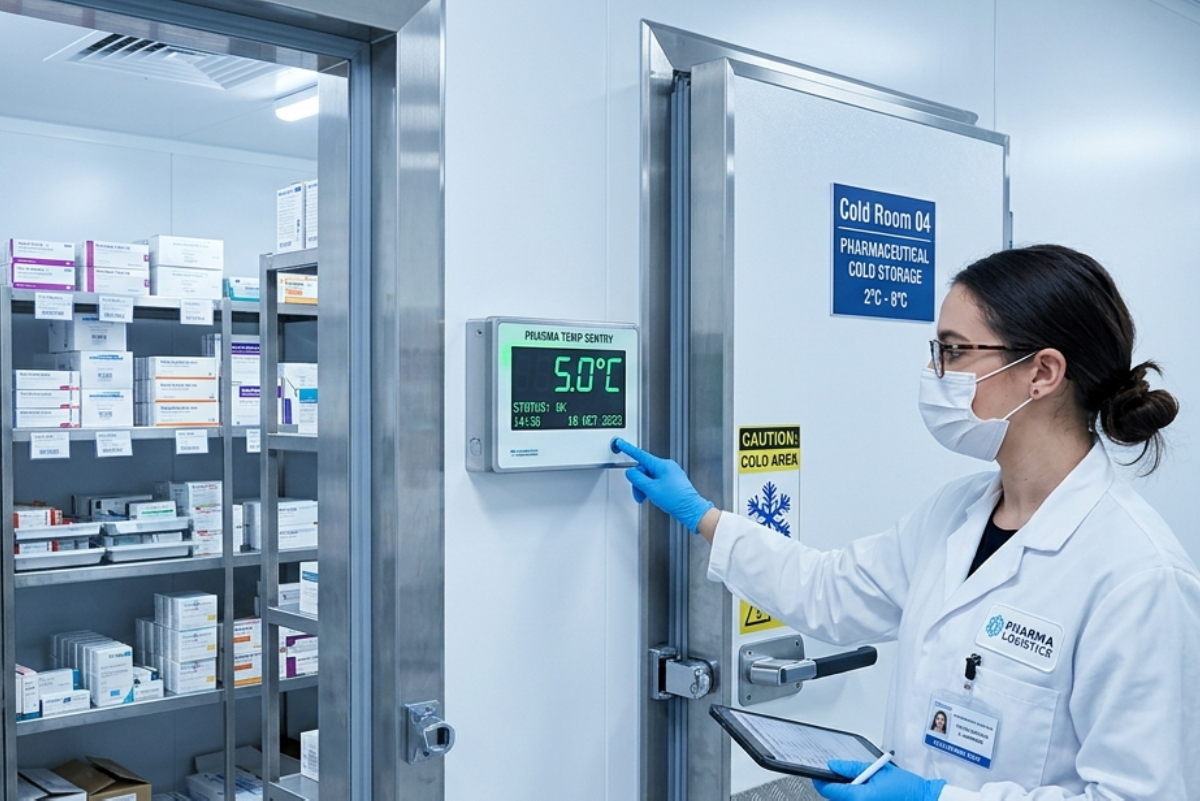
Pharmaceutical products are among the most sensitive goods stored and distributed anywhere in the world. Unlike food, where a slight temperature deviation might affect quality or shelf life, a compromised pharmaceutical product can pose direct risks to patient health. For companies operating in this space, cold storage is less of a logistics function and more of a clinical one.
This article looks at why precision temperature control is so fundamental to pharmaceutical cold storage and what that means in practice for companies operating in Singapore.
What “precision” actually means in pharma cold storage
In general commercial cold storage, maintaining a room at roughly the right temperature range is often sufficient. Pharmaceutical cold storage operates on an entirely different standard. Many biological medicines, vaccines and temperature-sensitive drugs require storage within a defined range, typically 2°C to 8°C for refrigerated products and -20°C or lower for frozen ones. Deviating outside these ranges, even briefly, can render a product ineffective or unsafe.
A cold storage room designed for pharmaceutical use must therefore maintain its set temperature consistently across the entire storage space, not just at the sensor point nearest the thermostat. This requires careful engineering of airflow, insulation and refrigeration capacity so that there are no warm or cold spots within the room that could affect product integrity.
Regulatory requirements shape everything
Pharmaceutical companies in Singapore operate under the oversight of the Health Sciences Authority, which enforces Good Distribution Practice (GDP) guidelines for the storage and distribution of medicinal products. These guidelines set out specific requirements for temperature monitoring, equipment qualification, deviation management and documentation.
What this means practically is that a pharma cold room cannot simply be built and put into service. It must be validated — a process that involves installation qualification, operational qualification and performance qualification to demonstrate that the room consistently performs within its specified parameters under real-world conditions. This validation process generates the documented evidence that regulators and auditors expect to see.
For pharmaceutical companies, this regulatory reality shapes every decision around cold room design and installation, from the choice of refrigeration equipment to the placement of temperature sensors and the specification of alarm systems.
Temperature mapping and monitoring
One of the most technically involved aspects of pharmaceutical cold storage is temperature mapping. Before a cold room can be approved for use, a mapping study must be conducted to identify temperature distribution across the entire space under representative conditions, including when the room is fully loaded with product.
This study reveals where temperature variations occur within the room, informs the optimal placement of permanent monitoring sensors and provides baseline data for ongoing performance review. It also identifies any design weaknesses that need to be addressed before the room goes into service.
Ongoing monitoring is equally demanding. Pharmaceutical cold rooms require continuous, automated temperature logging with alarm systems that alert responsible personnel when temperatures approach or breach defined limits. Manual checks alone are not considered sufficient. Data must be retained and available for inspection, and any deviation from the required temperature range must be formally investigated and documented, regardless of how brief or minor it appears.
The consequences of getting it wrong
The stakes in pharmaceutical cold storage are high and concrete. A temperature excursion that affects a batch of vaccines or biologics can result in product destruction, supply chain disruption and potential patient harm. Regulatory consequences can include product recalls, licence suspensions or fines. Reputationally, a cold chain failure is a serious incident for any pharmaceutical company and one that is difficult to recover from quickly.
Singapore’s pharmaceutical sector has grown significantly over the past decade, and the Economic Development Board recognises the industry as a key pillar of the manufacturing economy. As more complex biologics and cell and gene therapies enter the market, the cold chain requirements around them are becoming more stringent, not less.
Design considerations specific to pharma
Beyond temperature control, pharmaceutical cold rooms have design requirements that differ from those in food or logistics applications. Cleanability is a priority — surfaces, joints and drainage points must be designed to facilitate thorough cleaning without harbouring contaminants. Access control is often required to limit entry to authorised personnel. Segregation of different product categories within the same facility may be necessary to prevent cross-contamination or mix-ups.
Security is also a relevant consideration for companies storing high-value or controlled substances. Cold rooms in pharmaceutical settings may need to incorporate access logging and physical security measures that go beyond a standard padlock.
Understanding how cold room design differs across food, pharma, and logistics industries is a useful starting point for companies reviewing whether their current setup reflects the specific demands of their sector.
Building for long-term compliance
Pharmaceutical cold rooms are long-term infrastructure investments, and they need to be built with future regulatory expectations in mind, not just current ones. This means selecting refrigeration systems with proven reliability records, designing redundancy into critical components so that a single equipment failure does not result in a temperature excursion, and ensuring that the room can be re-validated efficiently as product lines or storage requirements change over time.
Maintenance also plays a more formal role in pharmaceutical cold storage than in other sectors. Planned preventive maintenance programmes must be documented, and any maintenance activity that could affect temperature performance needs to be followed by verification that the room is operating within specification.
Getting the right partner
Pharmaceutical cold storage is a specialised field, and the quality of the installation partner has a direct bearing on outcomes. A contractor who understands GDP requirements, validation protocols and the regulatory environment in Singapore will approach the project very differently from one with a purely commercial refrigeration background.
Cold Chain Refrigeration brings hands-on experience in designing and installing cold rooms for pharmaceutical and other regulated industries across Singapore. From initial design consultation through to installation, commissioning and ongoing maintenance support, the team works with clients to build cold storage solutions that meet both operational requirements and regulatory expectations from day one. Speak with us about your requirements, and we will assess the right approach for your facility.